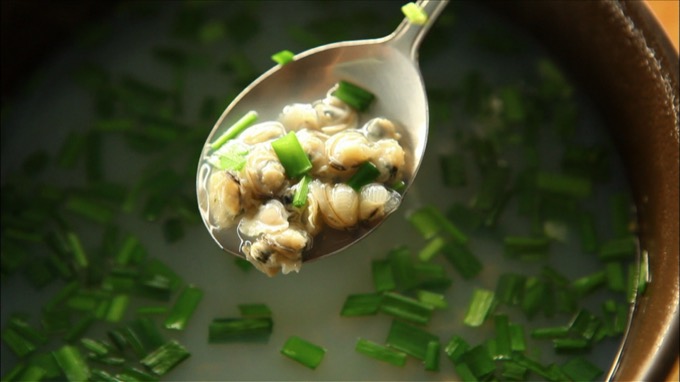
Freshwater Marsh Clam
One commonly used expression among Koreans is "siwonhada," meaning "cool" or "refreshing." This is rather difficult to understand for non-Korean speakers as Koreans use this expression to describe piping hot soup, essentially describing it as being "cool" or "cooling."
When Koreans describe something hot as "siwonhada," it conveys a feeling rather than a physical temperature-specifically, the sensation of relief or comfort that comes from consuming the food, like a hangover being relieved with the hot soup.
This expression is frequently used in relation to Korean soup dishes, especially when enjoying haejangguk (hangover soup) as a remedy for hangovers.
To break down alcohol, the human body requires energy and water. Haejangguk ingredients, such as bean sprouts, seonji (blood pudding), and dried pollack, are all high in protein.
Eating haejangguk replenishes energy through protein and carbohydrates while the soup's liquid content adds hydration, leading to that satisfying feeling of relief, prompting the spontaneous use of the word "siwonhada."
The story behind Freshwater Marsh Clam
When?
The peak season for freshwater marsh clam is from March, when flowers begin to bloom, until June, before the rainy season starts.
Where?
Hadong in Gyeongsangnam-do is located at the mouth of the Seomjingang River and is known as an ideal area for cultivating freshwater marsh clam.
The region boasts optimal conditions for these clams, which require a suitable mix of freshwater and seawater to thrive.
Many specialty restaurants serving freshwater marsh clam can be found around the Hwagae Market area and along Gyeongseo Road near the Songrim Roundabout in Hadong.
A Symbol of Abundance
Freshwater Marsh Clam: A Treasure of the Bountiful Ecosystem of Seomjingang River
Shellfish are among the ingredients that can evoke the expression "siwonhada." One type of clam, in particular, is especially so and that is the freshwater marsh clam.
Freshwater marsh clam thrives in brackish waters where rivers meet the sea.
The ideal habitat of freshwater marsh clam is at the mouth of the river, where sand begins to accumulate. This is precisely the case for the lower reaches of the Seomjingang River.
The Seomjingang River originates in Jinan and Jangsu in North Jeolla Province and flows toward Gwangyang, winding around Jirisan Mountain into South Jeolla Province.
The absence of a tidal dam allows for the development of brackish waters in the lower region, and the sedimentary terrain creates a favorable environment for freshwater marsh clam.
The people of Gurye, Hadong, and Gwangyang, which are located around the mouth of the river, pick freshwater marsh clam from spring to early summer each year.
The river is only about 1 m in depth, so people can step into it and rake the riverbed to harvest the freshwater marsh clam. Boats are sometimes used to harvest them in deeper areas.
How to Cook It
The easiest way to enjoy freshwater marsh clam is jaecheopguk (freshwater marsh clam soup).
Start by placing the freshwater marsh clams and water in a pot and boiling them. Once the freshwater marsh clams are cooked, remove the shells and separate the meat.
Be sure to save the water used for boiling the freshwater marsh clams do not discard it.
Next, transfer the reserved boiling water into a earthenware pot and bring it to a boil. Prepare some chopped buchu (Korean chives), which have a mild flavor and are rich in minerals.
Boil the soup, then top the soup with chopped buchu and the freshwater marsh clam meat to complete the jaecheopguk.
You can also transform the finished jaecheopguk into a hearty meal by adding rice, making jaecheop gukbap (freshwater marsh clam and rice soup), or adding noodles for jaecheop guksu (noodle soup with freshwater marsh clam).
Once you have the soup in front of you, take a spoon and taste the soup first. You will see why Koreans describe this soup as "siwonhada."
The freshwater marsh clam meat can also be used to make jeon (pan-fried battered dish). When mixed with buchu, jaecheopjeon becomes a savory dish that tantalizes the taste buds.
Freshwater marsh clam is often served as sashimi, typically prepared as jaecheop hoemuchim (spicy raw clam salad). Placing this spicy clam salad over warm rice makes for a delightful side dish.
In restaurants, you might also be provided with a bowl for bibimbap, allowing you to mix it with rice as you eat.
5 places to try Freshwater Marsh Clam
-
Yeoyeo Sikdang
If you want to get the basics of freshwater marsh clam dishes in the Hadong-eup center area, head to Yeoyeo Sikdang. This restaurant serves a rich bowl of jaecheopguk with a good selection of side dishes and a bowl of steamed rice.
Signature menu- Jecheopguk Baekban (freshwater marsh clam soup set menu) 10,000 KRW
- Jaecheopjeon 10,000 KRW
- Jaecheop Hoedeopbap (raw freshwater marsh clam bibimbap) 15,000 KRW
- Jaecheop Hoemuchim (small) 30,000 KRW / (medium) 40,000 KRW
- 92 Gyeongseo-daero, Hadong-eup, Hadong-gun, Gyeongsangnam-do
- Approx 12 km from Hadong TG on Namhae Expressway / Approx. 1.7 km from Hadong Station (regular trains) on Gyeongjeon Line
- 28 seats · Parking: Not available
- Menu: Korean
-
Seomjingang Jaecheop Guksu
This restaurant has gained fame on social media for its "scenic jaecheop guksu." Here, you can truly experience the natural flavors and aromas of freshwater marsh clam. The rich freshwater marsh clam broth blends perfectly with thin noodles, filling your mouth with umami. The crispy Jaecheopjeon is a delightful treat that pairs perfectly with makgeolli (unrefined rice wine).
Signature menu- Jaecheop Guksu 8,000 KRW
- Jaecheop Bibim Guksu (spicy noodles with freshwater marsh clam) 8,000 KRW
- Jaecheopjeon 10,000 KRW
- Jaecheop Baekban (freshwater marsh clam set menu) 12,000 KRW (minimum order for 2)
- 4276 Seomjingang-daero, Toji-myeon, Gurye-gun, Jeollanam-do
- Approx. 22 km from Gurye-Hwaeomsa TG on Suncheon-Wanju Expressway (same distance from Hwangjeon TG) / Approx. 19 km from Guryegu Station (KTX, regular trains) on Gyeongjeon Line
- 48 seats · Parking: Available (up to 15 spaces)
- Menu: Korean
-
Jinseon
This restaurant built up a strong and loyal fanbase in a small rural village in Gwangyang with just one dish, Jaecheophoe. Jinseon's version of this dish uses plenty of fresh vegetables, such as cucumber, paprika, zucchini, and cabbage, with pear and blanched freshwater marsh clams. You can enjoy it mixed with a dipping sauce of chojang (sweet and sour red chili paste) and sesame oil, or over rice like a jaecheop hoedeopbap.
Signature menu- Jaecheophoe (small) 30,000 KRW / (large) 50,000 KRW
- Jaecheop Jeongsik 13,000 KRW
- Jaecheophoe Siksa Set (raw freshwater marsh clam set menu) 22,000 KRW
- 43 Seonsojungang-gil, Jinwol-myeon, Gwangyang-si, Jeollanam-do
- About 1.9 km from Jinwol TG on Namhae Expressway / Approx. 6.9 km from Jinsang Station (regular trains) on Gyeongjeon Line
- 64 seats · Parking: No on-site parking; nearby parking available at Jinwol-myeon Public Parking Lot
- Menu: Korean
-
Buheung Jaecheop Sikdang
Like many other restaurants in Hadong, this restaurant serves freshwater marsh clam dishes. The restaurant is most famous for Jaecheophoe (raw freshwater marsh clam). This dish is served on a bed of pear, carrot, cabbage, cucumber, and other vegetables tossed with sweet and sour red chili paste. Another popular menu is the Modum Jeongsik (assorted freshwater marsh clam set menu), which has jaecheopguk, jaecheopjeon, and jaecheophoe.
Signature menu- Modum Jeongsik 18,000 KRW (jaecheophoe, jaecheopjeon, saengseongui, etc.) (minimum order for 2)
- Jaecheop Jeongsik (freshwater marsh clam set menu) 12,000 KRW
- Jaecheophoe (small) 30,000 KRW / (large) 40,000 KRW
- Jaecheop Hoedeopbap 15,000 KRW
- Jaecheopjeon 10,000 KRW
- 98 Gyeongseo-daero, Hadong-eup, Hadong-gun, Gyeongsangnam-do
- Approx. 12 km from Hadong TG on Namhae Expressway / Approx. 1.6 km from Hadong Station (regular trains) on Gyeongjeon Line
- 72 seats · Parking: Not available
- Menu: Korean
-
Hwanggeum Jaecheop Sikdang
This freshwater marsh clam restaurant overlooks the Seomjingang River. Its signature menu is the Jaecheop Special Jeongsik (freshwater marsh clam special set menu), a sumptuous table with freshwater marsh clam and hairy crab caught from the Seomjingang River. The food here is particularly fresh as all ingredients are prepared on the morning of the day. It is also quite close to Hwagae Market, Simni (10-ri) Cherry Blossom Road, and other famous springtime tourist sites in Hadong, so you don't have to head to the center of the township.
Signature menu- Jaecheop Special Jeongsik 27,000 KRW (minimum order for 2) (jaecheop hoemuchim, jaecheop buchimgae (freshwater marsh clam pancake), jaecheopguk, chamgetang (hairy crab soup), euneotwigim (deep-fried sweetfish), etc.)
- Jaecheop Modum Jeongsik 18,000 KRW (minimum order for 2) (jaecheop hoemuchim, jaecheop buchimgae, jaecheopguk, chamgejang (soy sauce marinated hairy crab))
- Jaecheop Hoemuchim (small) 30,000 KRW / (large) 40,000 KRW
- Jaecheop Hoedeopbap 15,000 KRW
- Jaecheopguk 10,000 KRW
- 3915 Seomjingang-daero, Hwagae-myeon, Hadong-gun, Gyeongsangnam-do
- Approx. 26 km from Gurye-Hwaeomsa TG on Suncheon-Wanju Expressway (same distance from Hwangjeon TG) / Approx. 20 km from Hadong Station (regular trains) on Gyeongjeon Line
- 40 seats · Parking: Available (up to 8 spaces)
- Menu: Korean
Photo: Educational Broadcasting System (EBS) (KOGL Type 1), Wikimedia Commons
Source: Korea Tourism Organization (Taste Your Korea), “K-Local Food Trip 33”, compiled July 2024; text reused with attribution, the guide’s photos are not. Restaurants are not ranked; hours and menus change, confirm before you go.