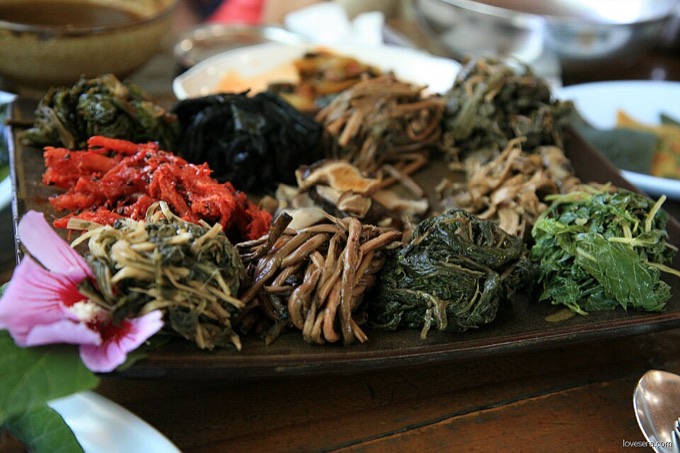
Wild Vegetables
One thing that surprises many first-time visitors to Korea is just how many mountains are visible up close from almost anywhere.
Whether among the skyscrapers in Seoul or on the beachfront, mountains are always in view.
Perhaps due to this proximity, it is no surprise that Korean cuisine makes extensive use of wild vegetables from the mountains.
The story behind Wild Vegetables
When?
Spring is the season for wild vegetables when frozen lands thaw and new shoots emerge from the ground.
The fragrance and flavor of wild vegetables are at their peak in spring and diminish as the season ends.
Where?
Many restaurants offer wild vegetable set menus near Pyeongchang-gun's major tourist sites (ski resorts, Buddhist temples, etc.).
Fresh wild are available at traditional markets or Hanaro Mart, operated by the National Agricultural Cooperative Federation.
What Do Koreans Mean by Wild Vegetables?
Wild vegetables, known in Korean as sanchae (lit. mountain vegetables), are a type of namul.
Namul is akin to salads in that it refers to vegetable leaves or stems cooked for human consumption. Koreans distinguish between domesticated and wild namul in that regard.
The former is called jaebae namul (cultivated vegetables), while the latter is called sanchae. In this context, wild vegetables refer to edible vegetables sourced from mountains.
Generally, such wild vegetables tend to have stronger flavor and fragrance than jaebae namul, and are often available only during specific seasons.
Why Koreans Enjoyed Wild Vegetables
Koreans have long enjoyed wild vegetables gathered from the fields and the mountains. According to historical records or oral tradition, there are nearly 800 types of edible plants in Korea.
These wild vegetables refresh the taste buds after winter's dullness with their unique fragrances and flavors.
In the past, it was difficult to get green vegetables during winter in Korea. Because Korea's Year-Round are clearly defined, it was difficult to farm or harvest vegetables during winter.
Kimchi was, in fact, the only vegetable that one could have in winter. After enduring the brutal winter, when green buds began to emerge, Koreans would use mugwort, the first plant to emerge in winter, to make soup or rice cakes.
That was their way to replenish Vitamin C after winter.
Other popular wild vegetables include shepherd's purse and wild chives. Typically, shepherd's these greens are blanched, wrung out, then tossed with sesame oil, soy sauce, minced garlic, and similar seasonings.
They are also commonly added to soybean paste soup, usually about 2 minutes before the soup is finished. In fact, shepherd's purse and wild chives pair quite well together.
Spring, the Season of Wild Vegetables
In spring, traditional markets and supermarkets alike are filled with wild vegetables, which serves as heralds of spring.
As the weather warms, these vegetables become tougher and lose some of their flavor, making spring the ideal time to enjoy them to your heart's content.
Some of the more well-known and popular wild vegetables include victory onion, cirsium, bitter lettuce, dandelion leaves, Korean valerian, snowy false lily of the valley, Asian plantain, short-fruit pimpinella, and Kamchatka goatsbeard.
One wild vegetable that can be found in early March, at the very beginning of spring, is butterbur. With deeply pink stems and small leaves, butterbur has a sweet and slightly bitter taste when tossed with soybean paste.
You can eat the stems or blanch the palm-sized leaves for wraps. Butterbur remains in season until the peak of summer.
Another popular vegetable is fatsia shoot, which, like ginseng, is rich in saponins and thus has a bitter fragrance. Fatsia shoots are typically enjoyed blanched or deep-fried and pair particularly well with grilled pork belly.
When grilling pork belly, try grilling fresh fatsia shoots as well. Heating the shoot releases the unique fragrance of fatsia shoot, which helps mitigate the fatty flavor of pork belly.
A relative of fatsia is castor aralia, whose shoots also have a bitter fragrance.
Siberian ginseng delivers a flavor that is even bitterer than fatsia or castor aralia, with a hint of gentle sweetness. Although sumac can be poisonous, it is highly valued among wild vegetable enthusiasts.
If you're not sensitive to sumac, it's worth a try.
Where to Enjoy Wild Vegetables
As more than 70% of Korea is covered in mountains, wild vegetables can be found in abundance everywhere.
But if you want to sample a variety of wild vegetables in one place, Gangwon State's Pyeongchang-gun beats all other options.
Pyeongchang is a region where many peaks belonging to Taebaeksan Mountain Range can be found, including the Odaesan National Park. You may recognize Pyeongchang from the PyeongChang 2018 Olympic Winter Games.
Pyeongchang is accessible by a KTX line, making it only an hour and a half from Seoul.
There are many restaurants that serve a variety of wild vegetables in Pyeongchang's traditional markets, around ski slopes, and at the entrance to Woljeongsa Temple of Odaesan Mountain.
How to Enjoy Wild Vegetables
Wild vegetables are in season from the end of winter to spring. When the day gets warmer and the frozen ground begins to thaw, green shoots begin to emerge.
These green shoots are beloved by Koreans, who enjoy preparing them with a variety of sauces.
While different cooks have different ways of preparing wild vegetables, such as tossing them in soy sauce or soybean paste, all take care to preserve the unique fragrance and flavors of these wild vegetables.
Sanchae bibimbap (wild vegetable bibimbap) or sanchae jeongsik (wild vegetable dish set menu) are great ways to sample these vegetables. The former can be found in restaurants that handle wild vegetables.
Some restaurants serve the sanchae bibimbap with "makjang" (Gangwon-style soybean paste made by keeping a higher ratio of soy sauce when soybean paste and soy sauce are separated, giving it a richer color and savorier flavor).
This sauce makes an ideal sauce for a bibimbap; however, to fully appreciate the natural fragrance and flavors of the wild vegetables, it is recommended to use the sauce sparingly.
Sanchae jeongsik, as the name suggests, offers a wider selection of wild vegetables. Depending on the restaurant, it may be accompanied by other Gangwon specialties, such as deodeok or dried pollack, which are seasoned and grilled.
These wild vegetables may be blanched and dried for storage in preparation for seasons when fresh wild greens are hard to find. Once stored this way, they are called mungnamul.
Although drying may slightly diminish their original flavor, it imparts a rich, savory taste.
7 places to try Wild Vegetables
-
Ssangdungine Gabyusl Sikdang
Though this restaurant specializes in chicken dishes, such as Baeksuk (whole chicken soup) or Dakbokkeumtang (spicy braised chicken), it is also known for Gondeurebap (thistle rice), which is made into a bibimbap with makjang (Gangwon-style soybean paste). This restaurant, with its long history, has welcomed many famous figures, including athletes from around the world who competed in the Winter Olympics.
Signature menu- Gondeurebap (thistle rice) 10,000 KRW
- Eomnamu Baeksuk (whole chicken soup with castor aralia) (4 servings) 70,000 KRW
- Mugeunji Baeksuk (whole chicken soup with aged kimchi) (4 servings) 90,000 KRW
- Dakbokkeumtang (spicy braised chicken) (4 servings) 70,000 KRW
- Otdak (braised chicken with sumac) (4 servings) 90,000 KRW
- 118-8 Ihyoseok-gil, Bongpyeong-myeon, Pyeongchang-gun, Gangwon-do
- Approx. 7.4 km from Pyeongchang TG on Yeongdong Expressway
- 80 seats · Parking: Available (up to 10 spaces)
- Menu: Korean, English, Japanese, Chinese
-
Odesan Minsok Sikdang
This restaurant is famous for its sanchae jeongsik, a meal featuring a variety of seasonal wild vegetables. Wild vegetables and mushrooms are collected in the mountains by the restaurant's owner, and the soybean paste is made in-house. Because it is located at the entrance to Woljeongsa Temple, you can visit the restaurant with the temple.
Signature menu- Sanchae Jeongsik 22,000 KRW
- Gondeure-namul-bap Jeongsik (thistle rice set menu) 25,000 KRW
- Gondeure-namul-bap (thistle rice) 13,000 KRW
- Hwangtae-gui Baekban (grilled dried pollack set menu) 17,000 KRW
- (Building 9, #1), 152 Odaesan-ro, Jinbu-myeon, Pyeongchang-gun, Gangwon-do
- Approx 9.9 km from Jinbu TG on Yeongdong Expressway
- 80 seats · Parking: No on-site parking; nearby parking available at Sanmun Public Parking Lot
- Menu: Korean
-
Heundeulbawi
This restaurant serves a great variety of flavors with wild vegetables cooked in nearly 100 different recipes. Rather than using strong sauce, the restaurant minimizes the cooking process to bring out the flavor and fragrance of the ingredients.
Signature menu- Heundeulbawi Sanchae Jeongsik 23,000 KRW
- Sollip Godeungeo (pine leaf mackerel) Sanchae Jeongsik 28,000 KRW
- Sollip Ganjanggejang (pine leaf soy sauce marinated crab) Sanchae Jeongsik 33,000 KRW
- 1 Taegi-ro, Bongpyeong-myeon, Pyeongchang-gun, Gangwon-do
- Approx. 6.9 km from Myeonon TG on Yeongdong Expressway
- 68 seats · Parking: Available (up to 10 spaces)
- Menu: Korean
-
Bongpyeong Traditional Market (« TRADITIONAL MARKET »)
This is the fifth-day market held in Bongpyeong-myeon on days ending in 2 and 7 of each month. It serves as the setting of Lee Hyoseok's novel When Buckwheat Flowers Bloom and a popular tourist site of Pyeongchang. The market sells buckwheat, the specialty of Bongpyeong-myeon, and various wild vegetables sourced from the Pyeongchang area. Operating Hours: Depends on the store.
- 280-6 Changdong-ri, Bongpyeong-myeon, Pyeongchang-gun, Gangwon-do
-
Pyeongchang Olympic Market (« TRADITIONAL MARKET »)
This fifth-day market can be found near Pyeongchang Bus Terminal. It is held on days ending in 0 and 5 of each month, but some stores remain open on days outside the market day. The market sells wild vegetables in season as well as Pyeongchang's folk dishes like pan-fried millet rice cake and buckwheat pancake. Operating Hours: Depends on the store.
- 55-6 Ha-ri, Pyeongchang-eup, Pyeongchang-gun, Gangwon-do (https://olympicmarket.modoo.at, Language: Korean)
-
Jinbu Traditional Market (« TRADITIONAL MARKET »)
This fifth-day market is held on days ending in 3 and 8 of each month. As the largest fifth-day market in Pyeongchang, you can find a great variety of foodstuff and items on offer. Operating Hours: Depends on the store.
- 140 Hajinbu-ri, Jinbu-myeon, Pyeongchang-gun, Gangwon-do
-
Hanaro Mart (« SALES CENTERS »)
Hanaro Mart is a supermarket run by the National Agricultural Cooperative Federation of Korea, which mostly offers agricultural products grown in the region. You can find Hanaro Mart across Pyeongchang, offering vegetables cultivated and harvested in the region. [Daegwallyeong Nonghyup Main Branch] 66 Daegwallyeong-ro, Daegwallyeong-myeon, Pyeongchang-gun, Gangwon-do - Contact: +82-33-335-5961 | Operating Hours: 08:30-20:00 | Parking: Parking lot available. [Pyeongchang Nonghyup Main Branch] 68 Baego-ro, Pyeongchang-eup, Pyeongchang-gun, Gangwon-do - Contact: +82-33-332-2533 | Operating Hours: 08:30-20:00 | Parking: Parking lot available. [Jinbu Nonghyup Jungang Branch] 27 Jinbujungang-ro, Jinbu-myeon, Pyeongchang-gun, Gangwon-do - Contact: +82-33-335-8244 | Operating Hours: 08:30-21:00 | Parking: Parking lot available.
Photo: Junho Jung (Flickr) (CC BY-SA 3.0), Wikimedia Commons
Source: Korea Tourism Organization (Taste Your Korea), “K-Local Food Trip 33”, compiled July 2024; text reused with attribution, the guide’s photos are not. Restaurants are not ranked; hours and menus change, confirm before you go.