Gochang Freshwater Eel
Like salmon, freshwater eel goes back and forth between freshwater and seawater. However, they move the other way around.
Whereas salmon are born in streams, head out to the sea, and come back in the spawning season, freshwater eels are born in the sea, come up to the stream to grow, then head out to the sea for spawning.
Areas where rivers and the sea meet were traditionally called "pungcheon," which is where the term "pungcheon jangeo (eel)" comes from, reflecting this migratory behavior of freshwater eels.
Gochang-gun in Jeonbuk State is a region famous for its freshwater eel. Freshwater eel farms are located around the Jujincheon Stream, that runs through the Gochang area, which accounts for over 30% of the national freshwater eel production.
Most of the freshwater eels we consume are farmed. However, this is only a partial form of aquaculture, as current farming techniques do not involve the spawning of freshwater eels.
This gap in knowledge arises from the lack of accurate research on where and how freshwater eels are born.
The method for supplying eel to farms relies on fishing. When juvenile eels, born in the open sea, swim upstream into rivers, they are captured.
Fishermen catch these juveniles and transfer them to farming facilities, where they are raised to a sufficient size for sale. Even though eels are supplied from farms, market prices can fluctuate, often due to variations in the catch of juvenile eels.
Freshwater Eel: Crispy on the Outside, Rich and Oily on the Inside.
The story behind Gochang Freshwater Eel
When?
Freshwater eel is most active in feeding when the river temperature is around 28 degrees Celsius, making its peak season in August and September.
If you visit Gochang, Jeonbuk-do, in September, you can enjoy freshwater eel along with the beautiful flower scenery of the red spider lilies at Seonunsa Temple.
Where?
Gochang, Jeonbuk-do, is Korea's top producer of freshwater eel.
Restaurants serving freshwater eel dishes are clustered around Seonunsa Temple, an old temple in Gochang (around Seonunsa-ro, Asan-myeon, Gochang-gun, Jeonbuk-do).
Where to Enjoy It
Gochang is one of the leading producers of freshwater eels in Korea, and the area near Seonunsa Temple is where many freshwater eel farms and restaurants can be found.
This is because Seonunsa Temple, the county's most famous tourist site, is located at the mouth of the stream that young freshwater eel comes back to.
Generally, freshwater eel can be ordered per kilogram in restaurants. It depends on the size of the eel in question, but a kilogram of freshwater eel corresponds to 2 or 3 freshwater eels.
In some cases, freshwater eel farms operate their own restaurants and offer freshwater eel at more affordable prices.
Some restaurants, among those that serve grilled freshwater eel, also offer mudflat eel. Mudflat eels are farmed in fenced-off areas in tidal flat areas.
Because they are farmed in an environment closest to nature, mudflat eels are more active than freshwater eels grown on farms, translating to a more savory flavor and chewier texture.
Grilled Until Golden
Freshwater eels are high in fat, protein, and Vitamin A, making them a popular food renowned for their nutrition in Korea. Koreans prepare freshwater eels in different ways.
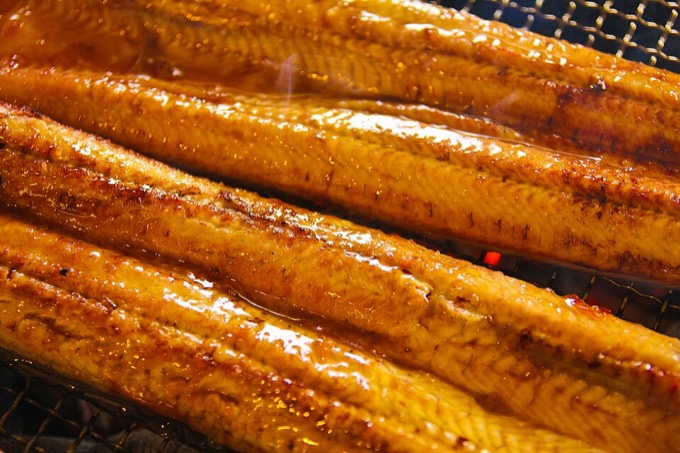
The most popular option is jangeogui (grilled eel). Eel prepared for grilling is placed on a grill over charcoal fire, seasoned with salt to make jangeo sogeumgui or with gochujang (red chili paste) to make jangeo yangnyeomgui.
Some restaurants grill the eel in the kitchen to maintain a consistent flavor, but in most cases, guests are responsible for grilling their own eel.
You have to flip the freshwater eels multiple times when grilling them because they are fatty, and their skin burns quite easily.
You also need to be careful when seasoning the eel, whether with salt or gochujang. When salt-grilling, you should salt the eel before it goes on the grill, while a gochujang-based sauce should be basted on the eel as it grills, taking care not to burn the sauce.
Once grilled, cut the eel into bite-sized pieces, transfer them to the edge of the grill, and start enjoying them one by one.
Jangeogui is also great with vegetable wraps. Place a piece of jangeogui, ginger, onion, garlic, and others on a leaf of lettuce or perilla, wrap it, and pop it into your mouth.
Vegetables help mitigate the fatty flavor of eels. Ginger, in particular, offers a spicy flavor to counterbalance the fishy flavor of eels and help their digestion.
3 places to try Gochang Freshwater Eel
-
Yeongi Sikdang
This restaurant is the first to offer grilled freshwater eel in Gochang. The eel is grilled in the kitchen, so you don't have to worry about the often smoky business of charcoal-grilled on the table.
Signature menu- Botong Jangeo (freshwater eel) (1 serving) 38,000 KRW
- Gaetbeol Jangeo (mudflat eel) (1 serving) 41,000 KRW
- Jangeotang (eel soup) 12,000 KRW
- 2727 Seonun-daero, Asan-myeon, Gochang-gun, Jeonbuk-do
- Approx. 9 km from Seonunsan TG on Seohaean Expressway / Located at Samin Intersection, Seonun-daero (National Road No. 22)
- 180 seats · Parking: Available (up to 30 spaces)
- Menu: Korean
-
Geumdan Yangman
This restaurant also operates a freshwater eel farm, so you can get freshwater eels at more affordable prices. The first floor of the building houses the freshwater eel store, and the restaurant is located on the second floor. You purchase live freshwater eel on the first floor, and the restaurant prepares the eel on the spot for you. You can either package and take the eel back or bring it to the second floor to grill it yourself.
Signature menu- Minmul Jangeo (Freshwater eel) (1kg) 66,000 KRW (may be subject to change with market prices)
- 51-10 Geomdang-gil, Simwon-myeon, Gochang-gun, Jeonbuk-do
- Approx. 17 km from Seonunsan TG on Seohaean Expressway / Located by Seonun-daero (National Road No. 22)
- 432 seats · Parking: Available (up to 100 spaces)
- Menu: Korean
-
Cheongwon Garden
This restaurant is one of the most positively reviewed restaurants serving freshwater eels near Seonunsa Temple's entrance for its clean ambience and delicious side dishes. If you order jangeogui here, the eel is salted or basted with sauce in the kitchen and brought to you for grilling.
Signature menu- Jangeo Yangnyeomgui (1 serving) 35,000 KRW
- Jangeo Sogeumgui (1 serving) 35,000 KRW
- Jangeotang 10,000 KRW
- 67 Seonunsa-ro, Asan-myeon, Gochang-gun, Jeonbuk-do
- Approx. 10 km from Seonunsan TG on Seohaean Expressway / Located by Seonun-daero (National Road No. 22)
- 100 seats · Parking: Available (up to 30 spaces)
- Menu: Korean
Photo: mino park (CC0), Wikimedia Commons
Source: Korea Tourism Organization (Taste Your Korea), “K-Local Food Trip 33”, compiled July 2024; text reused with attribution, the guide’s photos are not. Restaurants are not ranked; hours and menus change, confirm before you go.