Octopus
Muan Octopus
There's an old saying that "feeding a collapsed cow live octopus helps it regain strength."
Indeed, octopus is known for being rich in taurine, making it a great food for restoring energy.
The story behind Octopus
When?
The best season for octopus is from October to March, when they are most active in feeding.
Among these months, fall is when octopus is richest in flavor and nutrition.
Where?
If you want to experience octopus at its finest, it's recommended to visit Muan Octopus Street at: Seongnam 1-gil, Muan-eup, Muan-gun, Jeollanam-do.
The Pristine Tidal Flats of Muan
Muan is home to one of Korea's largest tidal flat regions, covering an area of 35.6 km2. The region is also renowned for its dedication to preserving a clean natural environment.
In 2001, Muan became the first area in Korea to be designated a wetland protected area, and in 2008, it was recognized internationally by being listed as a Ramsar site.
Thanks to its unspoiled ecosystem, Muan's tidal flats provide ideal conditions for a variety of organisms and marine life.
The clean environment and abundant food sources make Muan's tidal flats a perfect habitat for octopuses to thrive.
How to Catch Octopus
Octopuses are nocturnal mollusks that typically live in burrows in tidal flats during the day and come out to feed at night.
They are caught in shallow waters along Korea's west coast by using their nocturnal habits. During low tide, people search the exposed tidal flats for octopus burrows and dig up with a shovel.
Though labor-intensive, octopuses caught this way from the tidal flats are known for their soft texture and are highly prized.
Another method involves catching octopuses from a boat using a fishing tool called "junak." This consists of a fishing line with multiple hooks and bait attached.
A weight (often a tile) is tied to the end of the line, and hooks with bait (such as chilge*, a small crab) placed along the line. The junak is then lowered until the weight reaches the seabed, and it is pulled up at night to catch octopuses.
Sometimes, a trap (called "tongbal") is also used instead of the junak.
* Chilge is a type of small crab commonly found in tidal flats, measuring around 4 cm. It is a favorite food of octopus and is often used as bait for catching them. In the Jeonnam region, chilge are sometimes deep-fried or stir-fried and enjoyed as a dish.
The size of the octopus varies slightly depending on the method used to catch them. Octopuses caught by digging in tidal flats or using trotlines tend to be smaller and are often used in dishes like nakji tangtangi (chopped live octopus), nakjihoe (sliced raw octopus), or bibimbap.
Meanwhile, those caught using traps are relatively larger and are used for stir-fries or soups.
Various Octopus Dishes
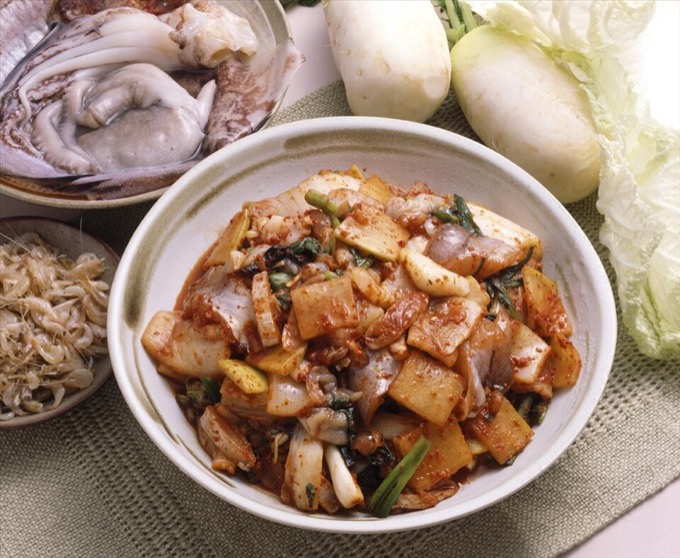
One of the most popular ways to prepare octopus is stir-frying. Slicing octopuses into bite-sized pieces and stir-frying them with vegetables and a spicy sauce complete nakji bokkeum (spicy stir-fried octopus).
The combination of the chewy, tender octopus with the smoky flavor of red chili paste sauce and the crisp, fragrant vegetables is a perfect match.
A recommended way to enjoy this dish is to make bibimbap by mixing the stir-fried octopus with rice. When ordering, ask for a separate bowl and mix the rice and octopus together for a delicious meal.
Nakji tangtangi is another delicacy in which live octopus is placed on a cutting board and chopped into small pieces by repeatedly striking it with a knife.
The term "tang" refers to the sound made when the knife strikes the cutting board.
Though it may resemble nakjihoe, nakji tangtangi is typically mixed with sesame oil sauce before being eaten, while nakjihoe is cut into bite-sized pieces and dipped in it.
While chopsticks are normally used, some prefer a spoon. To make handling the slippery octopus easier, wooden chopsticks are recommended.
For a refreshing and spicy soup, yeonpotang (octopus soup) is a must-try. The clear broth is light yet flavorful, making it a satisfying choice.
Pairing yeonpotang with other octopus dishes like nakji bokkeum, nakji muchim (octopus salad), or nakji horong (grilled whole octopus) will elevate the meal even further.
If you're eager to experience a variety of octopus dishes all at once, head to Muan Octopus Street. Several decades ago, octopus restaurants began to sprout up in the heart of Muan.
In 2020, Muan County launched a project to establish Muan Octopus Street. Now, more than 30 octopus specialty restaurants are all thriving and serving their signature dishes in this area.
3 places to try Octopus
-
Sook Octopus
It is an octopus specialty restaurant with over 40 years of tradition. Their most popular dish is Nakji Chomuchim (sweet and sour octopus salad), flavored with homemade rice wine vinegar.
Signature menu- Nakji Chomuchim (2 servings) 50,000 KRW
- Nakji Tangtangi (small) 50,000 KRW
- Nakji Bokkeum (2 servings) 50,000 KRW
- 172 Seongnam 1-gil, Muan-eup, Muan-gun, Jeollanam-do
- Approx. 3.5 km from Muan TG on Seohaean Expressway / Approx. 130 m from Muan Bus Terminal / Located within the Muan Octopus Street
- 56 seats · Parking: No on-site parking; nearby parking available at Urban Restoration Parking Lot (free for 2 hours) and Muan Octopus Street Parking Lot (paid)
- Menu: Korean
-
Dongsanjeong
You can enjoy dishes made with fresh octopus brought daily from the early morning auctions at a relatively affordable price. The recommended dish is yeonpotang, prepared by adding live octopus to a broth simmered for over 3 hours with 13 different ingredients. (Website: www.동산정.com, Language: Korean)
Signature menu- Yeonpotang (small) 50,000 KRW
- Nakji Chomuchim (small) 50,000 KRW
- Nakji Bokkeum (small) 50,000 KRW
- 173 Seongnam 1-gil, Muan-eup, Muan-gun, Jeollanam-do
- Approx. 3.5 km from Muan TG on Seohaean Expressway / Approx. 130 m from Muan Bus Terminal / Located within the Muan Octopus Street
- 70 seats · Parking: No on-site parking; nearby parking available at Urban Restoration Parking Lot (free for 2 hours) and Muan Octopus Street Parking Lot (paid)
- Menu: Korean, English, Chinese
-
Sageori Banjeom
Despite being located far from the town center, this renowned restaurant is bustling with people during lunchtime. The popular menu item is their Nakji Jjamppong (spicy seafood noodle soup with octopus), which features a whole octopus added to the spicy noodle soup.
Signature menu- Nakji Jjamppong 18,000 KRW (may be subject to change with market prices)
- 109 Bongwol-ro, Hyeongyeong-myeon, Muan-gun, Jeollanam-do
- Approx. 7.8 km from Muan Airport TG on Muan-Gwangju Expressway
- 30 seats · Parking: Available (up to 20 spaces)
- Menu: Korean
Photo: Korea.net / Korean Culture and Information Service (CC BY-SA 2.0), Wikimedia Commons
Source: Korea Tourism Organization (Taste Your Korea), “K-Local Food Trip 33”, compiled July 2024; text reused with attribution, the guide’s photos are not. Restaurants are not ranked; hours and menus change, confirm before you go.