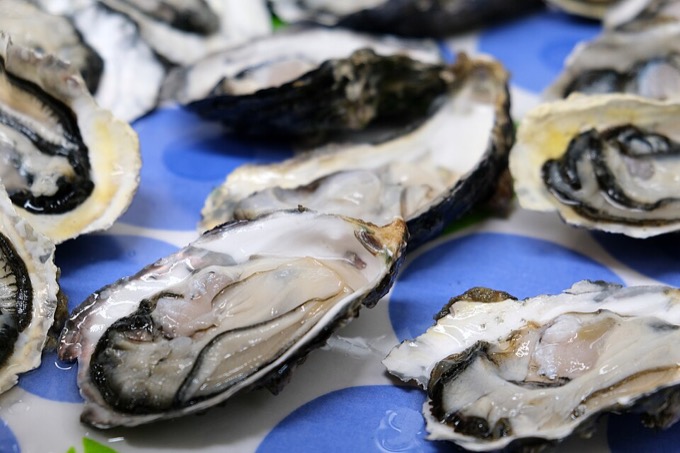
Oyster
Winter is the season of choice for oysters in Korea.
Oysters found in Korea are generally Pacific oysters, which are in season from late fall, when trees begin to shed their leaves, to early spring, when the flowers begin to bloom.
Thanks to the glycogen oysters build up to survive the cold sea temperatures, they boast an exceptional flavor and aroma during this time.
The story behind Oyster
Bawigul and Beotgul
Their spawning season is September to October, meaning they're at their peak in the summer.
Bawigul's availability in summer, exceptional size, and exclusivity-since they are not farmed in Korea-make it a rare, gourmet seafood.
Beotgul are generally found in brackish water and in Korea, they are found at the mouth of the Seomjingang River.
The name beotgul, meaning "cherry blossom oysters" in Korean, refers to them being harvested when cherry trees bloom as well as their shells opening widely like a flower in the water.
Another feature of the beotgul is that they are larger than chamgul. They have a milder aroma and less saltiness compared to sea-grown oysters, but are cherished for their tender texture and umami taste.
Enjoying Oysters Year-Round
Most restaurants serving oysters in Tongyeong only serve oyster dishes in winter (November-March), the season for chamgul. This is because most farms in the area utilize the subtidal method to farm oysters.
In other seasons, these restaurants serve dishes made with other types of seafood, such as meongge bibimbap (sea squirt mixed rice) and jeonbok ttukbaegi (abalone hot pot).
Some restaurants use frozen oysters to serve oyster dishes from spring to fall, but these naturally lack the freshness and flavor of live oysters.
Recently, however, the emergence of triploid oyster farming has made it possible for oyster lovers to enjoy oysters Year-Round.
Currently, they are mostly available through online orders, but a few years ago, an oyster bar in Tongyeong began offering triploid oysters, making it easier to find fresh oysters any time of year.
What Are Triploid Oysters?
Triploid oysters are genetically modified with an extra set of chromosomes compared to regular oysters, which have two sets.
Because they do not reproduce, they use the energy needed for reproduction to grow, making them typically larger than standard oysters.
One notable feature of triploid oysters is that they do not accumulate any toxins during spawning seasons, making their taste consistent throughout the year.
How to Enjoy Oysters
Oysters are most commonly enjoyed through three primary cooking methods.
The first is gul bossam (kimchi cabbage wraps with pork and oyster), where oysters are served with suyuk (boiled pork slices) and kimchi.
This is done most commonly by tossing oysters in kimchi seasoning and wrapping the oyster and suyuk in lettuce or kimchi cabbage.
The second is gulgui (grilled oyster) or guljjim (steamed oyster). These cooking styles are not as prevalent in Europe or the U.S. due to the higher prices of oysters there.
For gulgui, a flat iron plate is placed over charcoal, and the oysters, still in their shells, are grilled whole. As they heat up, the shells begin to open, indicating they're perfectly cooked.
Guljjim is more ideal for home consumption because it is quite easy to prepare: just put the oysters in a steamer and steam away.
Both methods keep the shells intact, so wearing gloves is recommended to avoid injury.
The finished grilled or steamed oysters are typically enjoyed with a dipping sauce made from chojang (sweet and sour red chili paste), but for those who want to fully savor the oysters' flavor and aroma, trying them without any sauce is also a great option.
The third is the gul gukbap (oyster and rice soup). While traditional gukbap (rice soup) is usually made with beef, pork, or chicken broth, in winter, oysters are often added to make a comforting soup.
Oysters and winter seaweeds are rich in taurine content, which helps mitigate fatigue and hangovers.
Indeed, a bowl of gul gukbap the day after drinking can bring you back to life quite quickly.
4 places to try Oyster
-
Daepunggwan
This restaurant serves seafood dishes made with fresh seafood in season. In spring, it serves sea squirt, abalone, and cutlassfish as mulhoe (cold raw fish soup), jeon (pan-fried battered dishes), sotbap (hot pot rice), and bibimbap. In fall and winter, oyster dishes take the fore. The restaurant is quite sizable, so it is ideal for group visits.
Signature menu- Set A (seokhwajjim (steamed oysters), saenggulhoe (raw oysters), gulmuchim (seasoned oysters), guljeon (oyster pancakes), gultwigim (fried oysters), haemul doenjangjjigae (seafood soybean paste stew), and gulbap (oyster rice)) 28,000 KRW
- Seokhwajjim (steamed oysters) 28,000 KRW
- Saenggulhoe (raw oysters) 18,000 KRW
- Gulbap (oyster rice) 13,000 KRW
- 29 Haesongjeong 2-gil, Tongyeong-si, Gyeongsangnam-do
- Approx. 6.3 km from Tongyeong Bus Terminal / Approx. 4.3 km from Tongyeong TG
- 92 seats · Parking: Available (up to 12 spaces)
- Menu: Korean, English
-
Hanmaeum Sikdang
This restaurant limits its offering to 100 tables per day to ensure the freshness of its dishes. Its signature dish is the Gul Samhap (oyster, kimchi, and pork belly combo). It also offers Guljeon (oyster pancakes), Gul Tangsuyuk (deep-fried oyster with sweet and sour sauce), Gul Eomuk (oyster and fishcake soup), and other oyster dishes.
Signature menu- Hanmaeum Gul Samhap (small) 75,000 KRW
- Hanmaeum Gul Samhap (1 serving) 40,000 KRW
- Guljeon 20,000 KRW
- Gul Tangsuyuk 20,000 KRW
- Gul Eomuk 10,000 KRW
- 6 Haesongjeong 1-gil, Tongyeong-si, Gyeongsangnam-do
- Approx. 6.3 km from Tongyeong Bus Terminal / Approx. 4.4 km from Tongyeong TG
- 152 seats · Parking: Available (up to 2 spaces)
- Menu: Korean
-
Tongyeong GulMadang
It's rare to find a restaurant in Tongyeong that serves oysters all year round. However, Tongyeong GulMadang offers oysters all year round. Its most popular menu is the set menu, which includes gul bossam (kimchi cabbage wraps with pork and oyster), guljeon (oyster pancakes), and gul yeongyang dolsotbap (nutritious oyster hot stone pot rice), and other oyster dishes.
Signature menu- Gul Jeongsik (oyster set menu) (1 serving) 25,000 KRW (minimum order for 2)
- 257-81 Donam-ro, Tongyeong-si, Gyeongsangnam-do
- Approx. 9.8 km from Tongyeong Bus Terminal / Approx. 8.9 km from Tongyeong TG
- 68 seats · Parking: No parking on-site; nearby parking available at the Tongyeong Cruise Ship Terminal Public Parking Lot
- Menu: Korean
-
PLAYBALL IN TONGYEONG
This place serves "Stella Maris," a triploid oyster produced in Tongyeong, all year round. The ambiance is reminiscent of a Western "sports pub" or "oyster bar," where you can enjoy various sports broadcasts while drinking. It has received certifications for "Guinness Master Quality" and "Heineken Star Serve Pouring Master" for strict quality control of draft beer.
Signature menu- Stella Maris 30,000 KRW
- Oyster Al Ajillo 23,000 KRW
- 104 Misuhaean-ro, Tongyeong-si, Gyeongsangnam-do
- Approx. 7.9 km from Tongyeong Bus Terminal / Approx. 7 km from Tongyeong TG
- 40 seats · Parking: Available (up to 5 spaces)
- Menu: Korean
Photo: kallerna (CC BY-SA 4.0), Wikimedia Commons
Source: Korea Tourism Organization (Taste Your Korea), “K-Local Food Trip 33”, compiled July 2024; text reused with attribution, the guide’s photos are not. Restaurants are not ranked; hours and menus change, confirm before you go.