Hanu
Korea's Premium Beef
Hanu: Korea's Premium Beef
The story behind Hanu
When?
Beef is available in supermarkets anytime, so it might seem like it doesn't have seasons. However, beef does have peak seasons: spring and fall-specifically from April to June and October to November.
During these times, cows can feed and fatten in moderate temperatures, making these months ideal for enjoying beef at its best.
Where?
Many restaurants serving Hoengseong hanu (Korean beef) are located in the center of Hoengseong-eup, around Hoengseong-gun Office (15, Taegi-ro, Hoengseong-eup, Hoengseong-gun, Gangwon-do) and Hoengseong Intercity Bus Terminal (377, Hoengseong-ro, Hoengseong-eup, Hoengseong-gun, Gangwon-do).
Hanu's Breed and Grade
Hanu originated from various breeds. In the past, these breeds were distinguished by their coat colors, with a total of nine distinct breeds.
Now, only three remain: One with black coat, one with a mixture of black and orange coat, and one with orange coat.
However, the primary factor influencing beef's flavor is not the cattle's coat but rather its age. Beef imported into Korea typically comes from cattle aged 18 to 24 months, but hanu beef is sourced from cattle aged 31 to 34 months.
This is extended nurturing period enhances the meat's fat content, enriching its flavor. Though the difference is only eight to twelve months, during this time, the beef develops richer marbling, flavor, taste, and texture.
Hanu is graded based on marbling, texture, maturity, the color of both the meat and fat. It ranges from grade 1++, the highest rating with the richest fat content, to grade 3, which is leaner and more affordable (1++, 1+, 1, 2, 3).
Hanu, An Enduring Classic
The flavor of hanu seems deeply embedded in Korean culture and cuisine. During the reign of King Yeongjo in the Joseon dynasty, it is said that a thousand cattle were butchered daily.
Considering Korea's total population at the time was around 7 million-about one-seventh of today's population this number is especially remarkable. For context, approximately 930,000 native cattle were butchered in 2023, amounting to about 2,500 cattle per day.
In the past, Koreans enjoyed hanu through meetings called "nallohoe." These gatherings, often held in winter, involved people sitting around charcoal braziers and grilled beef on a beoncheol-a pan resembling a pot lid used for making jeon (pan-fried battered dish) and stir-frying meat.
After grilling, they would sometimes deglaze the beoncheol with broth to create a soup dish, a precursor of what we know today as jeongol (hot pot) or bulgogi (marinated beef).
Where to Enjoy Hanu
Hanu can be found across Korea. In particular, Hoengseong has long been known as the home of hanu due to the region's pristine, expansive natural environment.
It is also the first place in Korea to have a hanu brand named after its region. Thanks to Hoengseong's cool climate, cattle raised in Hoengseong tend to be fattier, making the meat more tender and flavorful.
Shops offering hanu in Hoengseong can be divided into three broad categories: Jeongyuk sikdang (butcher restaurant), specialized hanu restaurants, and hanu buffet restaurants.
Jeongyuk sikdang is a unique Korean concept that combines a butcher shop with a grill restaurant. Upon entering, you'll often find a display case filled with various hanu cuts.
Simply purchase the cuts you want, then bring the meat to your assigned table. Most restaurants charge a table-setting fee of around 3,000 KRW to 4,000 per person, which includes vegetable wraps, ssamjang (a mixture of red chili paste, soybean paste, etc.), and basic side dishes.
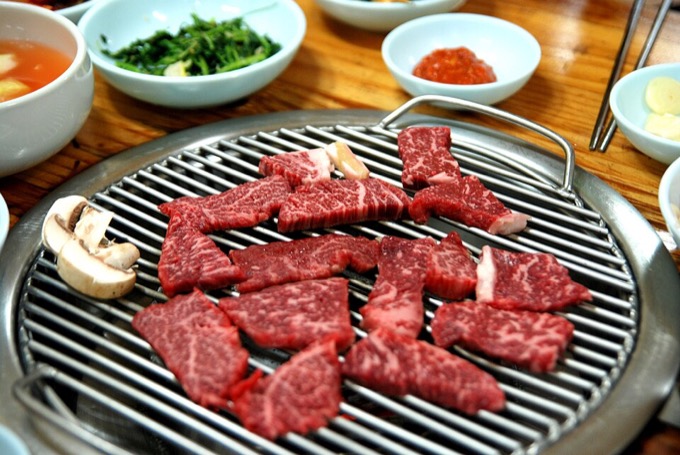
Once the grill in the center of your table is heated, you can grill the cuts you purchased and enjoy. Butcher restaurants let you select specific cuts based on your budget, often at lower prices than specialized hanu restaurants.
They also offer other types of dishes made with hanu, such as hanu bulgogi (Korean beef bulgogi), hanu gomtang (Korean beef bone soup), and hanu yukhoe bibimbap (Korean beef tartare bibimbap).
Specialized hanu restaurants offer more enhanced services, such as staff members who grill the meat for you. They often feature a wider variety of side dishes.
If you are willing to pay a bit more or prefer not to grill the meet yourself, these restaurants can be a good option. Additionally, such specialized restaurants often use high-quality charcoal, which helps drain excess fat and imparts a subtle, smoky aroma to the meat.
If you're looking for generous portions at affordable prices, all-you-can-eat hanu buffets are a great choice. Hanu buffet restaurants typically serve wet-aged grade 2 or 3 Hanu beef.
Most restaurants charge about 30,000 KRW per person, which is more affordable than a single portion of grade 1 hanu sirloin at specialty hanu restaurants.
Upon entering, you pay first and are then shown to your table. Once seated, you will receive your charcoal grill and first serving of meat.
Some restaurants grill the first serving for you. Basic side dishes like vegetable wraps or sauces are available at the self-serve bar.
At hanu buffet restaurants, you can enjoy as much meat as you like. Since grade 2 or 3 hanu tends to have less marbling, it's best to grill it until the surface is a rich, dark brown.
How to Enjoy Hanu
When you get beef steak, you often choose the level of doneness, such as rare or medium. This is because of the aging process.
Aged meat is often seared on the outside, whereas Korean-style grills frequently use unaged meat. Unaged, lean beef should be thoroughly cooked for optimal texture.
Hanu gui (grilled Korean beef) is best enjoyed with garlic and green chili pepper. Garlic is sometimes grilled with meat, as its sharp flavor softens into a pleasant sweetness when cooked.
Some restaurants grill the garlic in a small vessel with sesame oil.
You can also enjoy grilled meat with steamed rice, noodles, naengmyeon (cold buckwheat noodles), and doenjang jjigae (soybean paste stew). If you visit a restaurant in Hoengseong that serves doenjang jjigae, make sure to try it.
Hoengseong is located in Gangwon State, where the soybean paste tends to be darker. Locals refer to this as "makjang."
The darker color of makjang comes from using a higher ratio of soy sauce when separating the soybean paste from the soy sauce, giving doenjang jjigae made with makjang a richer, deeper flavor than that made with standard soybean paste. Adding slices of well-done meat to the stew can further enhance the flavor.
4 places to try Hanu
-
Hoengseong Chukhyup Hanu Plaza Main Branch
This restaurant is run by Hoengseong Chukhyup (Hoengseong Livestock Cooperative). You can purchase premium cuts of hanu, raised in the Hoengseong region, directly from the counter and grill them in the restaurant. After paying the table setting fees, help yourself to side dishes from the self-serve bar, where refills are also available. The restaurant also offers dishes made with hanu, such as Bulgogi and Hanutang (Korean beef soup). Other branches can be found in the Ucheon and Saemal areas.
Signature menu- Bush Assorted Grilled Meat 62,000 KRW
- Wonderful Assorted Grilled Meat 49,000 KRW
- Bulgogi 18,000 KRW
- Hanutang 15,000 KRW
- 337 Hoengseong-ro, Hoengseong-eup, Hoengseong-gun, Gangwon-do
- Approx. 3.4 km from Hoengseong TG on Jungang Expressway / Approx. 600 m from Hoengseong Intercity Bus Terminal
- 200 seats · Parking: Available (more than 100 spaces)
- Menu: Korean, English
-
Samjeong
This restaurant only serves the highest-rated 1++ Hoengseong hanu (Beef Marbling Score : 9) with exceptional marbling. It offers hanu, wet-aged using the restaurant's propriety methods, sourced from antibiotic-free cattle. All ingredients used in the restaurant are grown without pesticides. The dining area is divided into private rooms, and each table has a dedicated staff member to handle the grilling.
Signature menu- Samjeong Hanu (Samjeong Korean beef) 140,000 KRW
- 4536-3 Gyeonggang-ro, Dunnae-myeon, Hoengseong-gun, Gangwon-do
- Approx. 740 m from Dunnae TG on Yeongdong Expressway
- 28 seats (4 rooms for 4, 2 rooms for 6) · Parking: Available (up to 10 spaces)
- Menu: Korean
-
Raonia Hanu Buffet
This restaurant serves lower-grade but perfectly dry-aged hanu as an all-you-can-eat buffet. Each serving includes various cuts of beef, allowing you to sample and compare different parts of the hanu as you dine.
Signature menu- All-you-can-eat Hanu (1 serving) 37,000 KRW
- 6 Gowon-ro 398beon-gil, Dunnae-myeon, Hoengseong-gun, Gangwon-do
- Approx. 5 km from Dunnae TG on Yeongdong Expressway / Approx. 2.7 km from Exit 2 of Dunnae Station on Gyeonggang Line (KTX)
- 368 seats · Parking: Available (up to 20 spaces)
- Menu: Korean
-
Hoengseong Hanu Experience Hall
This space offers Hoengseong hanu for sale and includes an exhibition dedicated to it. It has a storytelling exhibition that introduces children to the stories about Hoengseong hanu, along with a Hoengseong hanu-themed ball pool, making it an ideal destination for families. (EXPERIENCE CENTER) [Program] Cooking Experience: Hanu bulgogi pizza, Hanu cream risotto, mandu, etc. Craft Experience: Leathercraft, Horncraft, Hanuri craft (yarn picture frame-making), etc. * Reservation required at least 3 days in advance via telephone. Operating Hours: 09:00-18:00 (closed on Mondays) | Admission: Free of Charge
- 41 Munye-ro, Hoengseong-eup, Hoengseong-gun, Gangwon-do
Photo: suksim (CC BY 2.0), Wikimedia Commons
Source: Korea Tourism Organization (Taste Your Korea), “K-Local Food Trip 33”, compiled July 2024; text reused with attribution, the guide’s photos are not. Restaurants are not ranked; hours and menus change, confirm before you go.