Wanggalbi
Grilled Jumbo Galbi
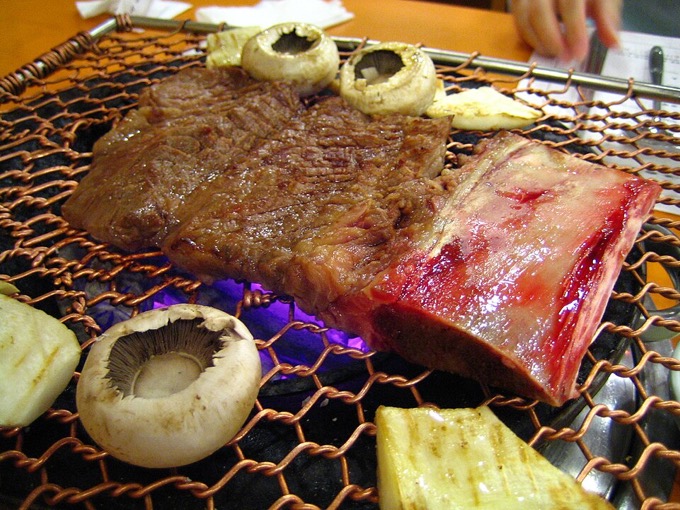
Suwon wanggalbi, a signature dish of Suwon, features thinly filleted beef wrapped around a large rib.
Marinated with salt and select seasonings, it boasts a tender, flavorful texture.
Wanggalbi: A Longtime Korean Favorite.
The story behind Wanggalbi
When?
Suwon Wanggalbi, a marinated grilled beef dish featuring jumbo galbi, is a delicious dish that can be enjoyed Year-Round.
Where?
Suwon is home to many Wanggalbi restaurants, many of them with longstanding traditions, making it easy to find an authentic taste.
History
The origins of Suwon wanggalbi can be traced back to Hwachunok, a haejangguk (hangover soup) restaurant established in 1945 near the Suwon Cattle Market.
Known for its generous portions of beef galbi in their haejangguk, Hwachunok stood out among local eateries and in 1956, the restaurant introduced grilled beef galbi as a new menu item, marking the beginning of the iconic Suwon wanggalbi tradition.
Hwachunok gained nationwide fame, attracting visits from high-profile politicians, including former President Park Chung-hee, who was known to enjoy its wanggalbi.
When Hwachunok closed in the early 1980s, its former kitchen staff established their own wanggalbi restaurants throughout Suwon. This spread led to Suwon wanggalbi becoming one of the city's most famous dishes.
Today, nearly 30 wanggalbi restaurants operate in Suwon. For a glimpse into the past, you can find a recreation of the original Hwachunok at the Suwon Museum of History.
Characteristics
There are two core differences that set Suwon wanggalbi apart from that of others.
The first is its unique marinade. Unlike the typical galbi marinade, which blends savory soy sauce with sugar for sweetness, Suwon wanggalbi uses refined salt, which is Korean sea salt dissolved in water to remove impurities and then re-crystallized.
This basic marinade combines refined salt and sugar at a 6:1 ratio, enhanced with black pepper, sesame oil, minced garlic, and other seasonings.
The second distinguishing feature of Suwon wanggalbi is its size. Known for its "jumbo" size, Suwon wanggalbi stands out from Idong-style galbi, which is typically cut to 3-5 cm lengths.
In its early days, Hwachunok famously served galbi pieces up to 17 cm long. While today's meat portions are smaller, they still exceed 10 cm, which is why "wang" (meaning "jumbo") is part of its name.
A Harmony of Meat and Fat
Beef galbi, or beef ribs, comprises of 13 bones arranged symmetrically from the neck to the rump along the spine.
Suwon wanggalbi specifically uses the central ribs, prized for their ideal balance of meat and fat, making them the most flavorful cuts.
Preparing Suwon wanggalbi requires meticulous effort. All fat and silverskin (fascia) surrounding the rib must be completely removed, a process that demands significant time and precision.
Once the ribs are fully trimmed, the meat is thinly filleted, marinated, and carefully wrapped around the rib, creating the signature Suwon wanggalbi experience.
Ribs closer to the neck are used for galbijjim (braised galbi), while those near the rump are reserved for galbitang (galbi soup). This is why many restaurants serving Suwon wanggalbi also offer galbijjim and galbitang on their menus.
How to Enjoy
Suwon wanggalbi is traditionally enjoyed with steamed rice, though it also pairs excellently with mul naengmyeon (cold buckwheat noodles in broth) and bibim naengmyeon (spicy buckwheat noodles).
Both mul and bibim naengmyeon belong to the naengmyeon family.
Mul naengmyeon features buckwheat noodles served in chilled beef broth or dongchimi (radish water kimchi) broth.
Bibim naengmyeon consists of buckwheat noodles tossed in a spicy sauce made from red chili paste, vinegar, chili powder, and minced garlic.
4 places to try Wanggalbi
-
Bonsuwon Galbi
With over 50 years of history, Bonsuwon Galbi is said to be one of Suwon's top three galbi restaurants. Diners can choose between Saeng-galbi (grilled, unmarinated galbi) to savor the natural flavor of the meat, or Yangnyeom-galbi (grilled, marinated galbi) for a richer, more savory taste.
Signature menu- Saeng-galbi (450g) 65,000 KRW
- Yangnyeom-galbi (450g) 60,000 KRW
- Galbitang (only available weekday lunchtimes) 18,000 KRW
- 41 Jungbu-daero 223beon-gil, Paldal-gu, Suwon-si, Gyeonggi-do
- Approx. 2.4 km from Exit 1 of GwanggyoJungang (Ajou Univ.) Station on Shinbundang Line
- 630 seats · Parking: Available (up to 80 spaces)
- Menu: Korean, English
-
Sambuja Galbi Woncheon Branch
Since 1983, this restaurant has upheld the tradition of Suwon wanggalbi. The galbi here is grilled over charcoal, adding a rich, smoky depth to the meat's flavor. A variety of flavorful side dishes accompany the meal, including gejang (marinated crab), enhancing the dining experience.
Signature menu- American Saeng-galbi (280g) 45,000 KRW
- American Yangnyeom-galbi (300g) 43,000 KRW
- Korean Saeng-galbi (180g) 69,000 KRW
- Korean Yangnyeom-galbi (200g) 53,000 KRW
- 335 Jungbu-daero, Yeongtong-gu, Suwon-si, Gyeonggi-do
- Approx. 3.8 km from Heungdeok IC on Yongin-Seoul Expressway / Approx. 2 km from Exit 1 of GwanggyoJungang (Ajou Univ.) Station on Shinbundang Line
- 118 seats · Parking: Available (up to 204 spaces, underground parking lot in the building)
- Menu: Korean, English, Japanese
-
Yeonpo Galbi
This restaurant occupies a remodeled public bath and inn, preserving the original chimney from its bathhouse days. Known for offering Suwon wanggalbi at relatively affordable prices, it also serves galbitang (galbi soup) exclusively during lunchtime on weekdays. Due to limited availability, galbitang often sells out quickly.
Signature menu- Saeng-galbi (450g) 60,000 KRW
- Yangnyeom-galbi (450g) 55,000 KRW
- Galbi Jeongsik (grilled galbi set menu) 31,000 KRW
- Saeng-galbi Jeongsik (grilled fresh galbi set menu) 33,000 KRW
- 56-1 Jeongjo-ro 906beon-gil, Paldal-gu, Suwon-si, Gyeonggi-do
- Approx. 3.1 km from Exit 1 of Hwaseo Station on Seoul Subway Line 1, located in front of Hwaseong Fortress' Hwahongmun Gate
- 280 seats · Parking: Available (up to 3 spaces)
- Menu: Korean, English, Japanese
-
Hwacheong Galbi
This restaurant offers Galbi Jeongsik, a set meal featuring Suwon wanggalbi at a reasonable price. Available only at lunchtime, the set includes grilled galbi, steamed rice, and a variety of side dishes, making for a satisfying and filling meal. Located near Hwaseong Fortress and the vibrant Haenggung-dong area (also known as Haengnidan Street), it's an ideal spot to enjoy a meal after exploring Suwon's famous sights.
Signature menu- Yangnyeom-galbi Jeongsik (Imported Beef) 32,000 KRW
- Saeng-galbi Jeongsik (Imported Beef) 35,000 KRW
- Korean Yangnyeom-galbi Jeongsik 35,000 KRW
- Korean Saeng-galbi Jeongsik 45,000 KRW
- 12 Changnyong-daero 41beon-gil, Paldal-gu, Suwon-si, Gyeonggi-do
- Approx. 2.2 km from Exit 6 of Maegyo Station on Suin-Bundang Line, behind Paldal-gu Office (near parking lot entrance and exit)
- 244 seats · Parking: Available (up to 4 spaces), further parking spaces available at Paldal-gu Office Public Parking Lot
- Menu: Korean
Photo: ayustety (Flickr) (CC BY-SA 2.0), Wikimedia Commons
Source: Korea Tourism Organization (Taste Your Korea), “K-Local Food Trip 33”, compiled July 2024; text reused with attribution, the guide’s photos are not. Restaurants are not ranked; hours and menus change, confirm before you go.