Kalguksu
Noodle Soup
The name of a dish often includes its main ingredient and cooking method.
For example, dwaejigukbap (pork and rice soup) is a dish where rice is mixed into a pork-based soup, and dwaeji bulgogi (pork bulgogi) describes pork cooked in a bulgogi style.
Hearing these names helps you easily imagine the dish's taste and appearance. However, this naming pattern doesn't always apply.
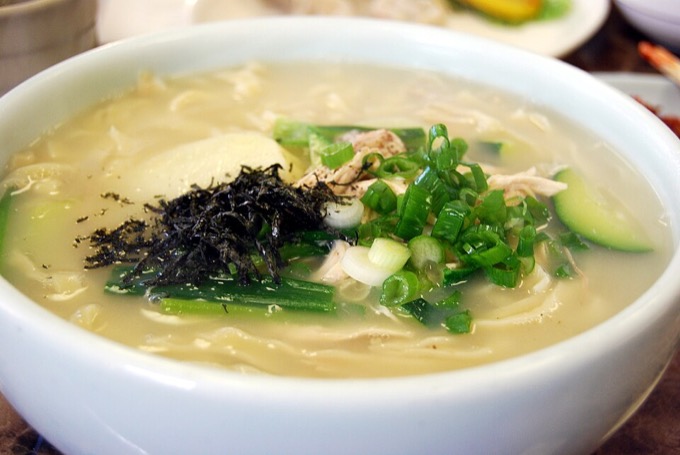
Kalguksu (knife-cut noodle soup) is named after the tool ("kal", meaning knife in Korean) used to make the noodles, rather than any particular ingredient.
Unlike janchi guksu (banquet noodles), which is made with factory-produced noodles, kalguksu emphasizes that the noodles are made by hand.
The story behind Kalguksu
When?
Kalguksu (noodle soup) is delicious in any season, but it's especially perfect on rainy or cold days when you crave a warm soup.
Where?
There are many great places to enjoy kalguksu throughout Daejeon, the transportation hub of South Korea.
Why Daejeon Is Famous for Kalguksu
Kalguksu is a relatively common dish, easily made by adding noodles to a soup instead of rice.
Despite its simplicity, Daejeon is always mentioned in connection with kalguksu, even though the dish didn't originate there. This is because Daejeon takes kalguksu seriously.
The city is home to over 700 kalguksu restaurants, a remarkably high number compared to other regions. Among them are many long-standing restaurants that have been serving kalguksu for decades.
Types of Kalguksu
Kalguksu can be broadly classified into two categories based on the type of broth used: meat-based and seafood-based.
Among meat-based kalguksu, the most common type uses beef bone soup. This flavor is familiar to Koreans, as it resembles other soups like seolleongtang (ox bone soup) and gomtang (beef bone soup), and the cooking method is widely known.
Chicken is another popular ingredient for making the broth. Sometimes, a whole chicken is boiled and enjoyed as a chicken soup, with noodles added to the broth afterward.
Haemul kalguksu (seafood noodle soup) often uses anchovies and Manila clams for its broth. Most janchi guksu found in traditional markets are made with anchovy-based broth.
Occasionally, you will find kalguksu prepared with a blend of anchovy broth and beef bone broth.
Bajirak kalguksu (clam noodle soup), common in Korea's western coastal regions, is distinguished by the generous use of Manila clams, cooked in a large pot according to the number of people being served.
Daejeon features some unique kalguksu varieties not commonly found elsewhere, such as dubu duruchigi kalguksu (noodle soup with stir-fried bean curd). The dish originated from adding noodles to the dishes at restaurants specializing in dubu duruchigi (stir-fried bean curd).
Duruchigi is a stir-fried dish of bean curd or meat with spicy seasoning, typically served with little to no broth. As such, dubu duruchigi kalguksu is a type of stir-fried noodles.
There is also noodle soup made with surf clams instead of Manila clams. Surf clams, small white clams shaped like a rounded triangle, are sometimes called "water gun clams" because they squirt water when sand is cleaned out.
While Manila clams release their flavor into the broth when cooked, surf clams retain their flavor inside their shells. This makes dongjuk kalguksu (noodle soup with surf clams) unique, as you can enjoy a rich broth flavor while savoring the clam meat.
Some restaurants serve noodles added to ojingeo jjigae (squid stew) as an extra option. They often add pickled radish for a spicy kick, enhancing the savory flavor of the broth as it cooks.
3 places to try Kalguksu
-
Sindo Kalguksu Main Branch
Established in 1961, this restaurant is still regarded as one of the best places for kalguksu in the Daejeon area. The broth, made from beef bones and anchovies, is enriched with perilla seed powder, creating a rich and nutty flavor. For the full experience, try pairing it with Suyuk (boiled pork slices) or Dubu Duruchigi (stir-fried bean curd).
Signature menu- Kalguksu 7,000 KRW
- Dubu Duruchigi 25,000 KRW
- Suyuk (small) 20,000 KRW
- 11 Daejeon-ro 825beon-gil, Dong-gu, Daejeon
- Approx. 270 m from Exit 3 of Daejeon Station on Daejeon Metro Line 1 (KTX and regular trains)
- 86 seats · Parking: Not available
- Menu: Korean
-
Sonamujip
The signature dish here is Ojingeo Jjigae (squid stew) made by adding whole radish and water to spicy stir-fried squid and simmering it into a hearty stew. However, most visitors who visit Sonamujip add noodles to their Ojingeo Jjigae, turning it into what's known as ojingeo kalguksu (noodle soup with squid). Ojingeo Jjigae is a great example of how people in Daejeon enjoy adding their own twist on kalguksu.
Signature menu- Ojingeo Jjigae 7,000 KRW
- Extra Serving of Noodles 1,000 KRW
- 59 Daejong-ro 460beon-gil, Jung-gu, Daejeon
- Approx. 720 m from Exit 1 of Daejeon Station on Daejeon Metro Line 1 (KTX and regular trains)
- 72 seats · Parking: No on-site parking; available at Daeheung-dong Public Parking Lot at 27, Daejong-ro 452beon-gil, Jung-gu, Daejeon
- Menu: Korean
-
OC Kalguksu
This is a specialty kalguksu restaurant known for its broth made with surf clams. When you order the Mulchong, or dongjuk jogaetang (surf clam soup), you'll be surprised by the generous amount of clams piled above the pot. The broth, made with anchovies and surf clams, is spiced to enhance its flavor, making it more flavorful and less plain.
Signature menu- Handmade Kalguksu 8,500 KRW
- Mulchong (dongjuk jogaetang) 14,000 KRW
- 13 Yetsintanjin-ro, Dong-gu, Daejeon
- Approx. 1.4 km from Exit 3 of Daejeon Station on Daejeon Metro Line 1 (KTX and regular trains)
- 88 seats · Parking: Available (up to 30 spaces)
- Menu: Korean
Photo: jslander (Flickr) (CC BY 2.0), Wikimedia Commons
Source: Korea Tourism Organization (Taste Your Korea), “K-Local Food Trip 33”, compiled July 2024; text reused with attribution, the guide’s photos are not. Restaurants are not ranked; hours and menus change, confirm before you go.